Use Cases
Your AI Just Emailed a Customer Without Permission
Add human approval gates to LangGraph agents with interrupt() and Command(resume=...), plus the state management bugs that will haunt you at 2 AM.
Feb 25, 2026
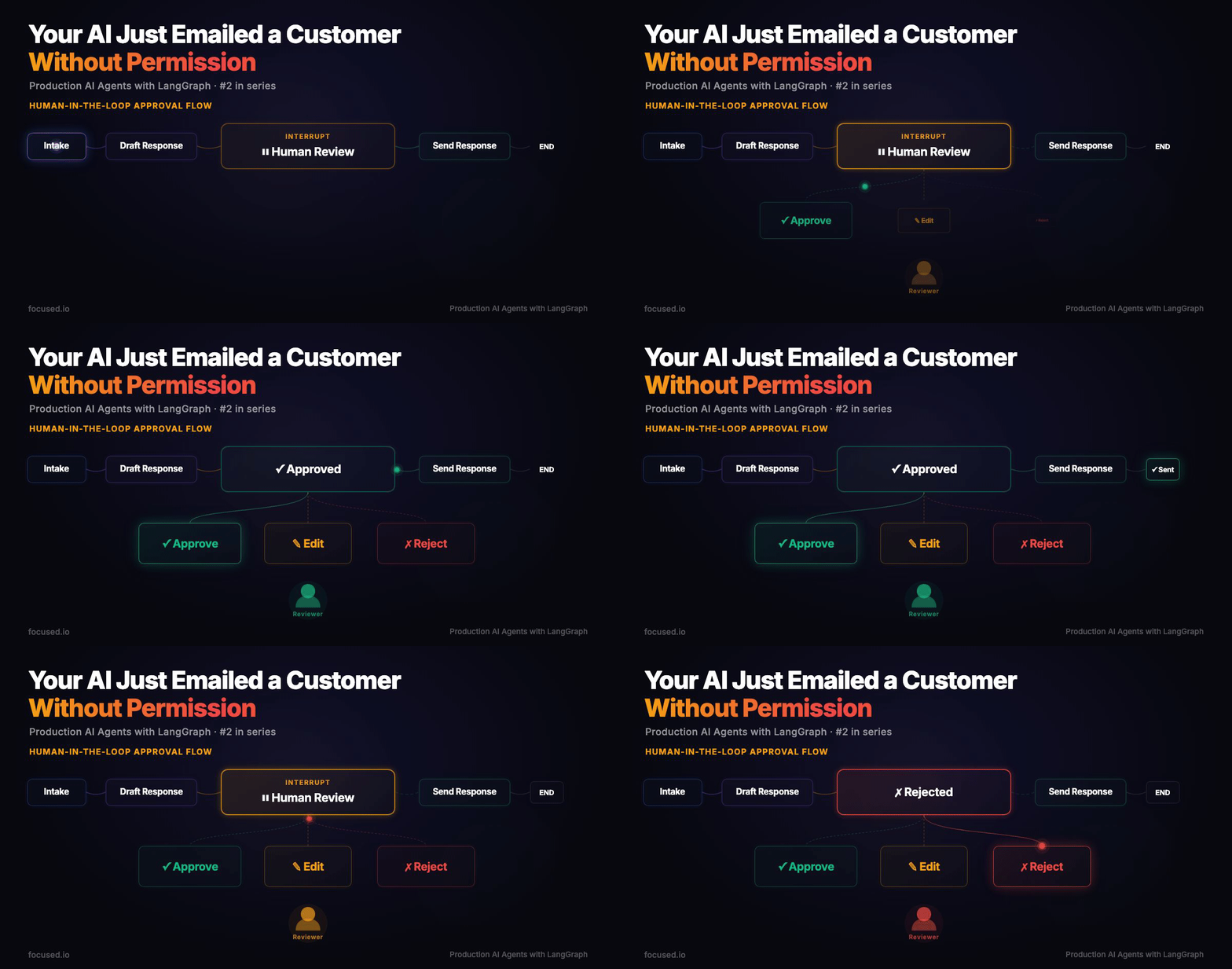
In a customer complaint handler for a fintech company you have drafted responses, checked tone, and verified responses to match company policy. Automated from end to end. Then, the agent sends a $4,200 refund approval to a customer who'd asked about a fee schedule. The LLM hallucinates the complaint, writes up a professional apology with a specific dollar amount, and fires it off before anyone on the team even knows.
Better prompts won’t help because the problem isn't what the model says, it's that nothing stops it from saying it.
To fix this you need an approval gate. Somewhere in the agent’s graph where execution... stops. State gets written to disk and a human looks at the draft. Only after they say "yeah, send it" does anything go out the door. LangGraph has a built-in primitive for this called interrupt.
Let's walk through the full pattern here. The code is straightforward but state management can trip you up.
The cost argument (if you need one)
If you're already sold on why AI shouldn't email customers unsupervised, skip this, but if you need to convince your PM, here's some napkin math:
What we’re building
A customer complaint response pipeline. Complaint comes in, AI drafts a response, a human approves or edits, system sends the final version.
[Intake] → [Draft Response] → [INTERRUPT: Human Review] → [Send Response] → ENDThe interrupt is where execution pauses. All the graph state (draft, original complaint, metadata, etc) gets checkpointed. It could be hours or days before someone reviews it and when they do, the graph will pick up right where it stopped.
Even in serverless environments interrupt is resilient. The Python process can crash. Server can restart. You resume with the same thread_id and LangGraph reloads everything from the checkpointer.
The state schema
Whatever the reviewer needs to see has to be in state before the interrupt fires.
from typing import TypedDict

from langchain_anthropic import ChatAnthropic
from langchain_core.messages import HumanMessage, SystemMessage
from langsmith import traceable

llm = ChatAnthropic(model="claude-sonnet-4-5-20250929", temperature=0)


class State(TypedDict):
    complaint: str
    customer_id: str
    draft_response: str
    review_decision: str
    reviewer_notes: str
    final_response: str
The nodes
Let’s build three nodes, draft, review, send. All with @traceable because six months from now when someone asks "who approved sending that email to the VP of procurement at our biggest account," you want a trace showing what the AI wrote vs. what a person changed.
@traceable(name="draft_response", run_type="chain")
def draft_response(state: State) -> dict:
    response = llm.invoke([
        SystemMessage(
            content="You are a customer service agent. Draft a professional, "
                    "empathetic response to the following complaint. Be specific "
                    "about next steps. Do NOT promise refunds or credits unless "
                    "the complaint clearly warrants one. Keep it under 150 words."
        ),
        HumanMessage(
            content=f"Customer ID: {state['customer_id']}\n\n"
                    f"Complaint: {state['complaint']}"
        ),
    ])
    return {"draft_response": response.content}
The review node is where interrupt() does its work.
from langgraph.types import interrupt

@traceable(name="human_review", run_type="chain")
def human_review(state: State) -> dict:
    decision = interrupt({
        "draft": state["draft_response"],
        "customer_id": state["customer_id"],
        "complaint": state["complaint"],
        "instructions": "Review the draft. Respond with a JSON object: "
                        '{"action": "approve" | "edit" | "reject", '
                        '"edited_response": "...", "notes": "..."}'
    })
    return {
        "review_decision": decision["action"],
        "reviewer_notes": decision.get("notes", ""),
        "final_response": decision.get("edited_response", state["draft_response"])
            if decision["action"] != "reject" else "",
    }
The dict you pass to interrupt() is the payload. It shows up in the __interrupt__ field of the graph's return value, which is what your UI or Slack bot reads to build the review screen. When someone calls Command(resume={"action": "approve"}), that dict becomes what interrupt() returns. The function resumes from the line right after the interrupt() call. It looks like a normal function call but there's a checkpoint boundary hiding inside it.
Send node. Don't send if it was rejected:
@traceable(name="send_response", run_type="chain")
def send_response(state: State) -> dict:
    if state["review_decision"] == "reject":
        return {"final_response": "[REJECTED] " + state["reviewer_notes"]}
    return {"final_response": state["final_response"]}
Wiring it up
The checkpointer makes interrupts durable. You can use InMemorySaver for dev, PostgresSaver for prod and if you forget the checkpointer and interrupt() throws a RuntimeError.
from langgraph.checkpoint.memory import InMemorySaver
from langgraph.graph import StateGraph, START, END

builder = StateGraph(State)

builder.add_node("draft", draft_response)
builder.add_node("review", human_review)
builder.add_node("send", send_response)

builder.add_edge(START, "draft")
builder.add_edge("draft", "review")
builder.add_edge("review", "send")
builder.add_edge("send", END)

checkpointer = InMemorySaver()
graph = builder.compile(checkpointer=checkpointer)
The full interrupt/resume cycle
Two invoke calls. First one runs until the interrupt and stops, the second one picks up where it left off.
from langgraph.types import Command

config = {"configurable": {"thread_id": "complaint-1234"}}

# Phase 1: Run until the interrupt
result = graph.invoke(
    {
        "complaint": "I was charged twice for my subscription last month. "
                     "Order #A-9912. I want a refund immediately.",
        "customer_id": "cust_8837",
    },
    config=config,
)

# The graph paused. Extract the interrupt payload.
interrupt_data = result["__interrupt__"][0].value
print(f"Draft for review: {interrupt_data['draft']}")
print(f"Customer: {interrupt_data['customer_id']}")

# Phase 2: Human reviews and approves (could be minutes or days later)
final_result = graph.invoke(
    Command(resume={
        "action": "edit",
        "edited_response": "We've identified the duplicate charge on Order #A-9912. "
                           "A refund of $29.99 has been initiated and will appear "
                           "in 3-5 business days. We apologize for the inconvenience.",
        "notes": "Verified duplicate charge in billing system. Approved refund.",
    }),
    config=config,  # Same thread_id — this is how LangGraph finds the checkpoint
)

print(f"Final response: {final_result['final_response']}")
That thread_id in the config matters more than anything else here. It's the key into the checkpointer. Without a thread_id you can't resume. We treat these as primary keys and map it to something stable in your system: ticket ID, conversation ID, etc.
Adding risk-based routing
The basic version sends everything through human review. Start there, but eventually reviewers get tired of approving "thanks for contacting us, we're looking into it" all day, and you'll want to auto-approve the low-risk stuff.
from pydantic import BaseModel, Field


class RiskAssessment(BaseModel):
    risk_level: str = Field(description="low, medium, or high")
    reason: str = Field(description="Why this risk level was assigned")


risk_llm = llm.with_structured_output(RiskAssessment)


@traceable(name="assess_risk", run_type="chain")
def assess_risk(state: State) -> dict:
    assessment = risk_llm.invoke([
        SystemMessage(
            content="Assess the risk level of this customer service response. "
                    "high = involves money, legal, account changes, or could "
                    "be interpreted as a binding commitment. "
                    "medium = emotional topic, could escalate. "
                    "low = simple acknowledgment, FAQ, status update."
        ),
        HumanMessage(
            content=f"Complaint: {state['complaint']}\n\n"
                    f"Draft response: {state['draft_response']}"
        ),
    ])
    return {"review_decision": assessment.risk_level}


def route_by_risk(state: State) -> str:
    if state["review_decision"] == "low":
        return "send"
    return "review"


builder_v2 = StateGraph(State)

builder_v2.add_node("draft", draft_response)
builder_v2.add_node("assess", assess_risk)
builder_v2.add_node("review", human_review)
builder_v2.add_node("send", send_response)

builder_v2.add_edge(START, "draft")
builder_v2.add_edge("draft", "assess")
builder_v2.add_conditional_edges("assess", route_by_risk, {"send": "send", "review": "review"})
builder_v2.add_edge("review", "send")
builder_v2.add_edge("send", END)

graph_v2 = builder_v2.compile(checkpointer=InMemorySaver())
Fair warning: you've now introduced a second LLM call as a gate, and that gate can be wrong in both directions. Under-classify risk and messages go out without review. Over-classify and reviewers are right back to rubber-stamping everything. Run the classifier in logging-only mode for a couple weeks first (route everything through review, but record what the classifier would have done and use long term memory to tune the classifier). Then start skipping reviews on low-risk messages after you trust the data.
The bugs
The demo works great... but...
Lost thread_id
Someone approves a draft in Slack. The integration pulls out the approval decision but constructs a new thread_id instead of looking up the one stored with the interrupt payload. Now Command(resume=...) creates a fresh graph where the input is an approval decision, not the complaint.
This happens a lot. Store the thread_id alongside the interrupt payload when you surface it to reviewers. Put it in a database. Put it in the Slack message metadata, Do not lose it.
Stale state
Reviewer opens the draft at 11:30. Goes to lunch. Comes back at 1pm and hits approve. In the meantime, the customer sent two more messages and someone on the support team already replied manually. The approved draft is now responding to a conversation that moved on.
LangGraph has no idea. It resumes from the checkpoint, which is frozen in time. Fix this by putting a created_at timestamp in the interrupt payload and checking it against the customer record's last_updated_at on resume. If anything changed, re-draft.
Double resume
Shared review queue. Two reviewers see the same pending draft. Both click approve. Depending on the checkpointer implementation, the second resume is either a no-op or an error, but by then the send logic already fired on the first one. Maybe that's fine. Maybe you just sent duplicate emails.
Build in idempotency to check if the thread already has a review_decision before doing anything with the resume.
Interrupt reordering
Two interrupt() calls in one node (say, one for policy review and one for tone). LangGraph matches resume values to interrupts by position, not by name. There are no names. Refactor and swap the order, the policy answer goes to the tone check and vice versa.
Don't put multiple interrupts in one node, instead use separate nodes.
Tracing across the gap
Interrupt-based workflows leave a gap in the LangSmith timeline where the human review happened. The draft trace ends, then hours later the resume trace starts, and nothing connects them unless you're deliberate about it.
from langsmith import tracing_context

ticket_id = "TICKET-4821"
config = {"configurable": {"thread_id": ticket_id}}

# Phase 1: Draft
with tracing_context(
    metadata={"ticket_id": ticket_id, "phase": "draft"},
    tags=["production", "complaint-handler", "phase-1"],
):
    result = graph.invoke(
        {
            "complaint": "Your app crashed and I lost 3 hours of work.",
            "customer_id": "cust_2291",
        },
        config=config,
    )

# ... time passes, human reviews ...

# Phase 2: Resume
with tracing_context(
    metadata={"ticket_id": ticket_id, "phase": "resume", "reviewer": "jane@company.com"},
    tags=["production", "complaint-handler", "phase-2"],
):
    final = graph.invoke(
        Command(resume={"action": "approve", "notes": "Looks good."}),
        config=config,
    )
Put the ticket ID in the metadata for both phases. Now you can filter in LangSmith and see the full lifecycle of a single complaint even though draft and resume were separate invocations. The reviewer field in phase 2 is your audit trail.
Evals
You need to know if drafts are any good before a human ever sees them.
Dataset setup and evaluators live in evals.py in the companion repo:
from langsmith import Client, evaluate
from openevals.llm import create_llm_as_judge

from complaint_handler import graph

ls_client = Client()

DATASET_NAME = "complaint-handler-evals"

if not ls_client.has_dataset(dataset_name=DATASET_NAME):
    dataset = ls_client.create_dataset(
        dataset_name=DATASET_NAME,
        description="Human-in-the-loop complaint handler evaluation dataset",
    )
    ls_client.create_examples(
        dataset_id=dataset.id,
        inputs=[
            {
                "complaint": "Charged twice for order #A-1234. Want a refund.",
                "customer_id": "cust_001",
            },
            {
                "complaint": "App crashes every time I open the settings page.",
                "customer_id": "cust_002",
            },
            {
                "complaint": "Your CEO's tweet was offensive. Cancelling my account.",
                "customer_id": "cust_003",
            },
        ],
        outputs=[
            {
                "must_mention": ["refund", "order", "A-1234"],
                "risk": "high",
            },
            {
                "must_mention": ["crash", "settings", "investigating"],
                "risk": "medium",
            },
            {
                "must_mention": ["feedback", "understand", "account"],
                "risk": "high",
            },
        ],
    )
Three evaluators. LLM judge for draft quality, keyword coverage, and a check for unauthorized promises:
DRAFT_QUALITY_PROMPT = """\
Customer complaint: {inputs}
AI draft response: {outputs}

Rate 0.0-1.0 on empathy, accuracy, and professionalism.
Deduct points if the draft promises specific remedies (refunds, credits)
without explicit authorization.
Return ONLY: {{"score": <float>, "reasoning": "<explanation>"}}"""

draft_judge = create_llm_as_judge(
    prompt=DRAFT_QUALITY_PROMPT,
    model="anthropic:claude-sonnet-4-5-20250929",
    feedback_key="draft_quality",
    continuous=True,
)


def coverage(inputs: dict, outputs: dict, reference_outputs: dict) -> dict:
    """Did the draft actually address the complaint specifics?"""
    text = outputs.get("draft_response", "").lower()
    must_mention = reference_outputs.get("must_mention", [])
    hits = sum(1 for t in must_mention if t.lower() in text)
    return {"key": "coverage", "score": hits / len(must_mention) if must_mention else 1.0}


def no_unauthorized_promises(inputs: dict, outputs: dict, reference_outputs: dict) -> dict:
    """Did the draft promise refunds or credits without authorization?"""
    text = outputs.get("draft_response", "").lower()
    dangerous_phrases = ["refund has been", "credit has been", "we will refund",
                         "we will credit", "compensation of"]
    violations = sum(1 for p in dangerous_phrases if p in text)
    return {"key": "no_unauthorized_promises", "score": 1.0 if violations == 0 else 0.0}


def target(inputs: dict) -> dict:
    """Run the graph until the interrupt (draft phase only)."""
    config = {"configurable": {"thread_id": f"eval-{inputs['customer_id']}"}}
    result = graph.invoke(inputs, config=config)
    return {"draft_response": result.get("draft_response", "")}
no_unauthorized_promises catches the failure mode from the top of this post. If the draft says "a refund has been initiated" when nobody authorized a refund, it scores zero. Run this eval every time you change the system prompt.
if __name__ == "__main__":
    results = evaluate(
        target,
        data=DATASET_NAME,
        evaluators=[draft_judge, coverage, no_unauthorized_promises],
        experiment_prefix="complaint-handler-v1",
        max_concurrency=4,
    )
    print("\nEvaluation complete. Check LangSmith for results.")
When to Human In The Loop
If AI is writing things that go to customers, you need a gate. Processing refunds, updating account records, anything you can't undo with a quick "sorry about that" email. Regulated industries need the gate plus an audit trail of who approved what.
You don't need this for internal stuff. Summarizing meeting notes, running analysis for a dashboard, generating reports that a human reads.
TL;DR
The two function calls: interrupt() and Command(resume=...). Pause execution, persist state, resume later.
Most of the work is everything around those two calls. Thread IDs getting lost, the world changing during the review gap, two reviewers approving the same draft, traces that need to connect across a timeline gap of hours or days.
Start by routing every response through review. Reviewers will complain. Good. Measure which categories they rubber-stamp, run your evals, and only then start auto-approving the boring stuff.
Technical References
We’ll use the information you provide to respond to your enquiry. Learn more about how we handle your personal data in our Privacy Policy.
/Contact Us

Modernize your legacy with Focused
Get in touch