Blog
Salesforce MCP Turns CRM Integration Into an Agent Runtime Problem
Salesforce MCP changes CRM integration from UI automation into runtime-owned identity, approvals, retries, idempotency, and trace work.
Jun 6, 2026

Harrison Chase wrote the useful version of the trend in one sentence: every platform will have a headless version. Salesforce, as we all know, made that useful trend concrete by providing Headless 360 for agents through APIs, MCP tools, Salesforce tools, and CLI commands. Salesforce Headless 360 exposes Salesforce capabilities through APIs, MCP tools, and CLI commands, so no one has to pretend the agent's only path is to click through Lightning.
This is a more significant integration change than the announcement suggests. The caller changes from a person or batch of data running through a deterministic code path to an agent running through a reasoning loop. That agent can pick tools, decide the order in which to invoke them, re-run failed work, invoke other products, and handle cross-product setup and coordination for the selected task.
The CRM caller changed
Salesforce describes Headless 360 as a platform shift for agents that call APIs, invoke MCP tools, and run CLI commands. Trailhead's quick look says Salesforce becomes a programmable system where data, workflows, and business logic are accessible through APIs, MCP tools, and CLI commands. Integration patterns are not changed by this new platform offering, yet the call scale, execution order, metadata exchanged, idempotence, governance, and testing all do change. Salesforce's own integration architecture post names the new consumer plainly: in 2026, the new consumer is the agent.
Enterprise teams should realize that the protocol is making the Salesforce platform available to the agent runtime. Claude Code, Codex, Agentforce, Cursor, or a custom LangGraph agent can all sit on the other end of the protocol. Availability is table stakes. Runtime behavior is where safety lives.

UI guardrails stop counting
The simplest way to get in trouble with Headless CRM is to view MCP as the cleaner automation channel: less screen scraping, fewer fragile black-box UI selectors, better tool descriptions. Fine.
Salesforce warns that a business rule that exists only in the user interface will not apply to agents interacting through MCP. Page and object layouts, Dynamic Forms, read-only fields and objects, guided screen flows, and the rest apply to humans interacting with the UI. They do not automatically apply to agents running tools and automations via MCP.
A tool that updates an opportunity stage, for example, has to enforce the appropriate rule on the platform or service layer. The tool to cancel bookings has to handle duplicates. What happens if an agent triggers this again before the cancellation actually takes effect? A tool to create quotes has to first understand which permissions and fields are allowed to be modified by this model and what the relevant side effects of updating a quote would be. That latter class of model can be clever and powerful. Also bad if designed lazily.
But in order to work well, the simplest tool has to be able to answer basic questions: who or what is behind the current tool call, which Salesforce identity backs it, what permissions belong to that identity, whether the call is safe to retry, which side effects need approval, what happens if tool B is called before tool A, and which trace shows the model decision that led to the CRM record mutation.
These are boring questions. They are also the integration architecture.
MCP packages the interface
MCP is doing real work here. Salesforce's MCP support announcement says one MCP server can plug into any AI app or agent that understands MCP. Agentforce includes a native MCP client, central registry support, policy support, and MuleSoft support to connect existing APIs to MCP servers.
That packaging layer is valuable. The catalog still has to be loaded, selected, scoped, and audited, which is why eager-loading every MCP tool into context turns into a runtime decision rather than a feature added for convenience.
The interface an agent uses to interact with a service to produce work is a product, not a protocol checkbox. While a platform can be fully packaged as a service with a good interface for human interaction, the interface used by an agent to execute work in the platform as a programmable system is a different animal altogether. I would make the same argument we made in MCP Is Packaging. Agent-Operable Interfaces Are the Product: the product is the safe agent-operable interface.
The Salesforce Hosted MCP Server post makes the consequence concrete. Salesforce says Claude Desktop and Claude Code can run SOQL queries, modify records, execute actions, invoke flows, call Apex, use Apex REST, call AuraEnabled methods, and work through Named Query APIs. Standard Salesforce user permissions still apply, and connection happens through an External Client App and OAuth.
Workload identity is the concept of having a delegate or workload authenticate to a system or service. The runtime should own the credential for delegated identity and manage expiration, auditing, and scope. This is the same boundary in AI Agent Authentication Starts With Workload Identity, now applied to Salesforce MCP APIs instead of generic tools.
The runtime owns the loop
Agent runtime is an abstract term, partly because it gets abused. Here it is concrete. The Salesforce MCP call becomes a unit of work stored in a task queue. If the agent created a quote and then the worker that did the work expired before the opportunity update, the runtime has to decide whether to replay the lost task, compensate the quote, or ask a human for assistance.
Recent refinement of vocabulary at LangChain HQ. First, to clarify a couple of terms: Harrison Chase had laid out a framework/runtime/harness view of DeepAgents, with LangChain being the framework, LangGraph the runtime for DeepAgents, and DeepAgents themselves being a harness for LangGraph work. Then LangChain’s production Deep Agents runtime post lays out what he means by the runtime in that model: durable execution of runs of arbitrary length, memory, multi-tenancy, human-in-the-loop, observability, sandboxes, scheduling, MCP, A2A, and webhooks. That runtime, in turn, is made agent-operable by the existence of Model Context Protocol tools exposed as CRM actions, with a managed task queue that automatically checkpoints work interrupted for any reason, for example interruption of long-running account cleanup, restart of the deploy that was running the agent in the first place, and so on. LangSmith core capabilities docs spell out managed task queues with automatic checkpointing as a core runtime capability.
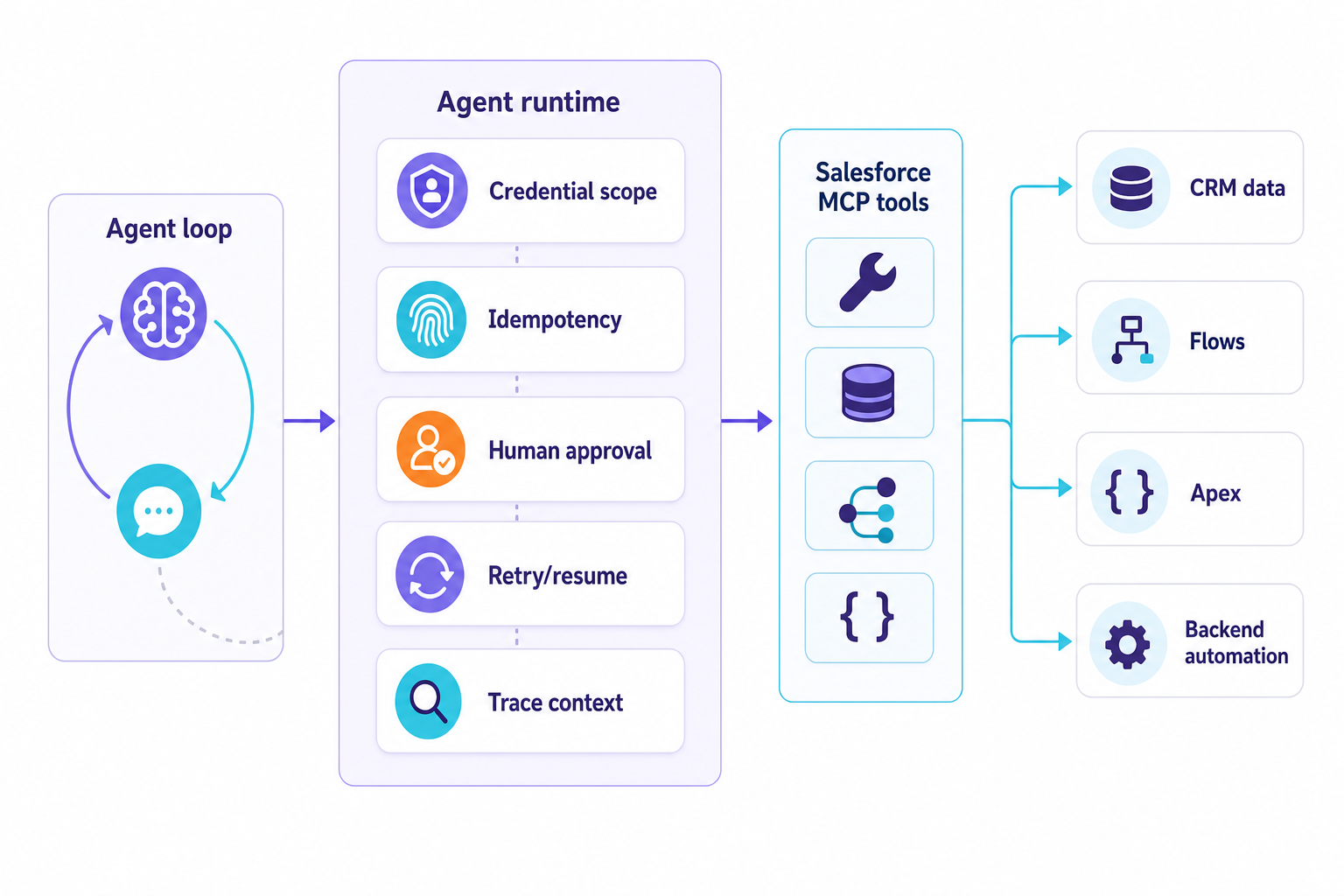
A CRM integration without a runtime layer to manage all of the long running tasks (account cleanup, etc.) will be great until that task gets approved by a human, the deploy that had the agent running on it restarts, and nobody knows what Salesforce record was modified by what model decision. The runtime conversation from LangChain Interrupt Moved into the Runtime matters outside of LangChain announcements. The Salesforce MCP makes CRM action agent-operable. The runtime makes that agent operable and governable.
Browser automation does not go away
Headless platforms do not kill off browser agents, because products still expose only human surfaces to execution. Agents can then be used to automate those human surfaces in order to generate compact snapshots, refs, sessions, recording, etc. including the ability to playback, as well as full control over the network activity and even the on-disk state of the agent under test. An example of such a product is Vercel's agent-browser, built for products that are exposed only through human interfaces.
A critical insight is that if Salesforce exposes MCP tools and corresponding APIs to agents, then forcing the agent to interact with the corresponding human interface (in a browse-oriented manner) is simply a matter of self-inflicted latency. API-Based Web Agents reported WebArena success rates of 14.8% for regular browsing agents, 29.2% for agents accessing APIs directly, and 38.9% for hybrid agents. Machine interfaces are substantially shorter trajectories than the corresponding human interface for a large set of tasks, and thus easier to get right. Shorter trajectories can fail faster, which is useful in the end, even. A better tool can therefore quickly produce better data, and a more portable protocol can make a wrong action portably wrong.
The trajectories though are shorter. Badly chosen tools will fail fast. Better tools, or even just better work done with better tools, will turn to better data. And the simplest portable protocol can make the worst action the easiest to port.
Traces have to cross the CRM boundary
I would add observability and tracing to the list of Headless 360 features worth taking seriously. Agentic CRM work will fail in fascinating ways and logging of integration work as is done in traditional integration work will not be enough. A purely deterministic integration will record every request and every response. An agentic integration on the other hand will include information about the planner’s state, the context that was retrieved, the model output that was generated, the tools that were chosen, the Salesforce actions that were permitted, the field level validation, the automations that were triggered, the retry behavior, and the approval activity for handoffs that require a human.
Honeycomb's agent-era observability post frames agent telemetry as spans and fields which answer a set of questions: what changed after a deploy, where handoffs failed, which retries occurred, and how tool usage, cost, latency and quality changed.
Again, this is closely related to the work we have previously outlined in Agent Traces Need to Cross the MCP Boundary. Therefore, by “integration work” here we mean work that can be followed by an integrator in terms of individual traces for individual runs that, when followed, contain information about the individual action taken by the integrator and all of the preceding action taken by the agent to plan and prepare for that single run. Those individual traces, therefore, must contain information for the planner span, the MCP client span, the MCP server span, the individual CRM API call or calls, and the subsequent automated actions. Those individual traces must also contain sufficient trace context so that the individual integrator following the traces can understand the individual runs taken by the agent in full.
But, as with all things, there are open issues. This 2026 MCP deployment patterns paper lays out standardization of MCP discovery and invocation, plus production gaps around identity propagation, tool budgeting, structured error semantics, server contracts, user context, timeouts, and runtime observability for agent execution traces. These look like things which would form a pretty good backlog for full Salesforce MCP adoption.
Build the runtime before the agent gets useful
Salesforce MCP is a tremendous asset to integration-heavy enterprises because it reveals the agent-usable surfaces on the platform, instead of simply putting a chat bot on top of the existing human CRM interface.
Beyond the prompts, I would start with an “ownership map” for this runtime. Specifically: within Salesforce, what are all the tools that can be executed by an agent. How do credentials for these tools get set up and managed. How do business rules that currently reside in the UI get ported to runtime. What are the properties of each tool (read-only, idempotent, approval-gated, side-effecting, …). How does each action call get a correlation ID passed in as a parameter. How does trace context propagate across the MCP boundary. Where are handoffs to humans for approval and how does runtime resume after approval is granted.
Then let the agent work. The enterprises that get this right will not brag about a chat window updating Salesforce. They will show how records were touched in a series of steps by an agent, with specific actions along the way. In each case a trace can be reviewed by the integrators, developers, finance, security, and engineering. The trace represents the complete workflow: automated work, manual approvals, safe retries, and the unsafe action that failed.
In summary, the Salesforce MCP protocol is important because it makes possible a new set of work that can be done in production. The protocol is easy; the runtime is hard.
We’ll use the information you provide to respond to your enquiry. Learn more about how we handle your personal data in our Privacy Policy.
/Contact Us

Modernize your legacy with Focused
Get in touch